
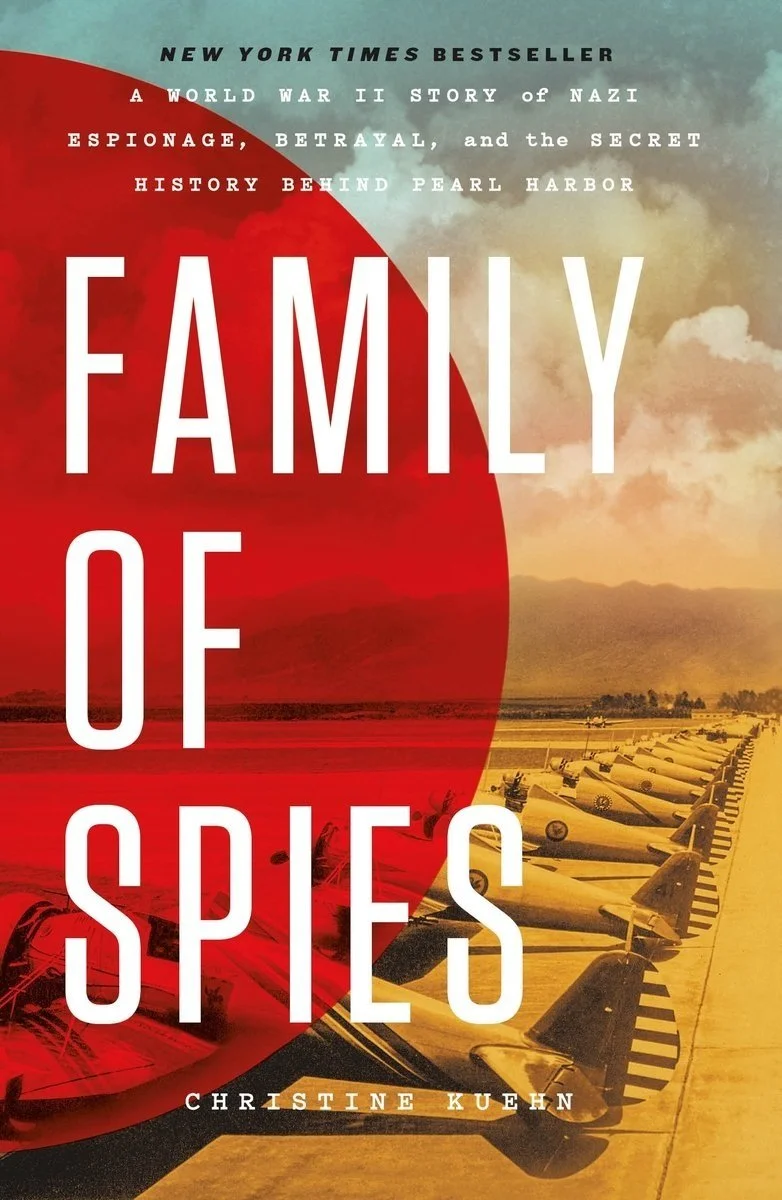
Family of Spies by Christine Kuehn
We will plan to meet at the entrance of Ashworth Park in Des Moines, Iowa, on the West side of the Des Moines Art Center, unless weather or whim changes our mind. Please email me at sherry@storiedgiftgs.com closefr to the date if you have questions.
Surely this must be historical fiction.
Here’s the premise: In 1930s Germany, a teenage girl has an affair with chief Nazi propagandist Joseph Goebbels. When he somehow discovers she is half-Jewish, her immediate family (excepting one ardently Nazi brother) is banished to Hawaii, where mother, father and daughter are tasked with spying for the Japanese — and facilitating the attack on Pearl Harbor.
Decades later, an American writer inherits this unlikely story and the resulting generational trauma. She sets out to uncover more details, spurring an intermittent, emotional 30-year quest and, finally, this book, Family of Spies.
Which, it turns out, is not fiction, but rather an astonishing blend of history and memoir.
“Christine Kuehn was cocooned in the sanctity of a quiet suburban life when a mysterious letter in 1994 pierced that bubble,” the author’s biographical blurb states. The letter, from a screenwriter, seeks information about a grandfather involved with the Nazis. It sends the skeptical Kuehn and her husband to a bookstore, where, in the World War II section, sure enough, they find scattered references to a man named Otto Kuehn and his daughter, Ruth. Both are linked to anti-American espionage.
By this point, Otto and his wife, Friedel, are dead. So, too, is Leopold, the brother who stayed behind and fought for Germany during the war. But living witnesses remain: Christine’s father, Eberhard, and, even more tantalizingly, Ruth herself.
“You don’t need to know about the family, the past, or Pearl Harbor,” Ruth had told Christine years earlier. Christine’s father, too, had supplied only “vague, whitewashed snippets” about that past.
But after some prodding, Eberhard Kuehn shares memories of his Hawaiian boyhood, an idyll of swimming, surfing and fishing during which he was unaware of the family’s spying. When the surprise Japanese attack on Pearl Harbor happened, on Dec. 7, 1941, he was 15 and, though not yet a citizen, thoroughly American. He enlisted in the U.S. Army as soon as he could, fought at Okinawa, and remained estranged from his parents for the rest of his life.
As Christine investigates, Eberhard, always a teller of fantastical stories, is gradually ravaged by dementia. His recollections fade, leaving her to continue her fraught pilgrimage through family history alone.
As for Ruth — if this were indeed a novel, the climax would be a confrontation between aunt and niece, with attendant revelations. But Ruth is intent on concealment. On a visit to Germany after her mother’s death, she and another brother, Hans, burn a cache of family papers. She dies having kept her secrets.
Kuehn’s narrative weaves back and forth between the history itself and her quest to discover and decipher it. She reports deeply on the intricacies of espionage and counterespionage in Hawaii, relying largely on FBI files. Her structure and style are clear and effective. But it is really the improbability of the tale that hooks readers.
Its precipitating events take place in Berlin, where Ruth, like the rest of the family, is immersed in Nazi culture. Encountering Goebbels, a vicious antisemite who is also a charming womanizer, she succumbs, and for a while he does, too. But it turns out that her biological father is not Otto Kuehn, a failed businessman trying to rise in Nazi ranks, but a Jewish architect with whom Friedel was involved before the marriage. That, of course, is a problem.